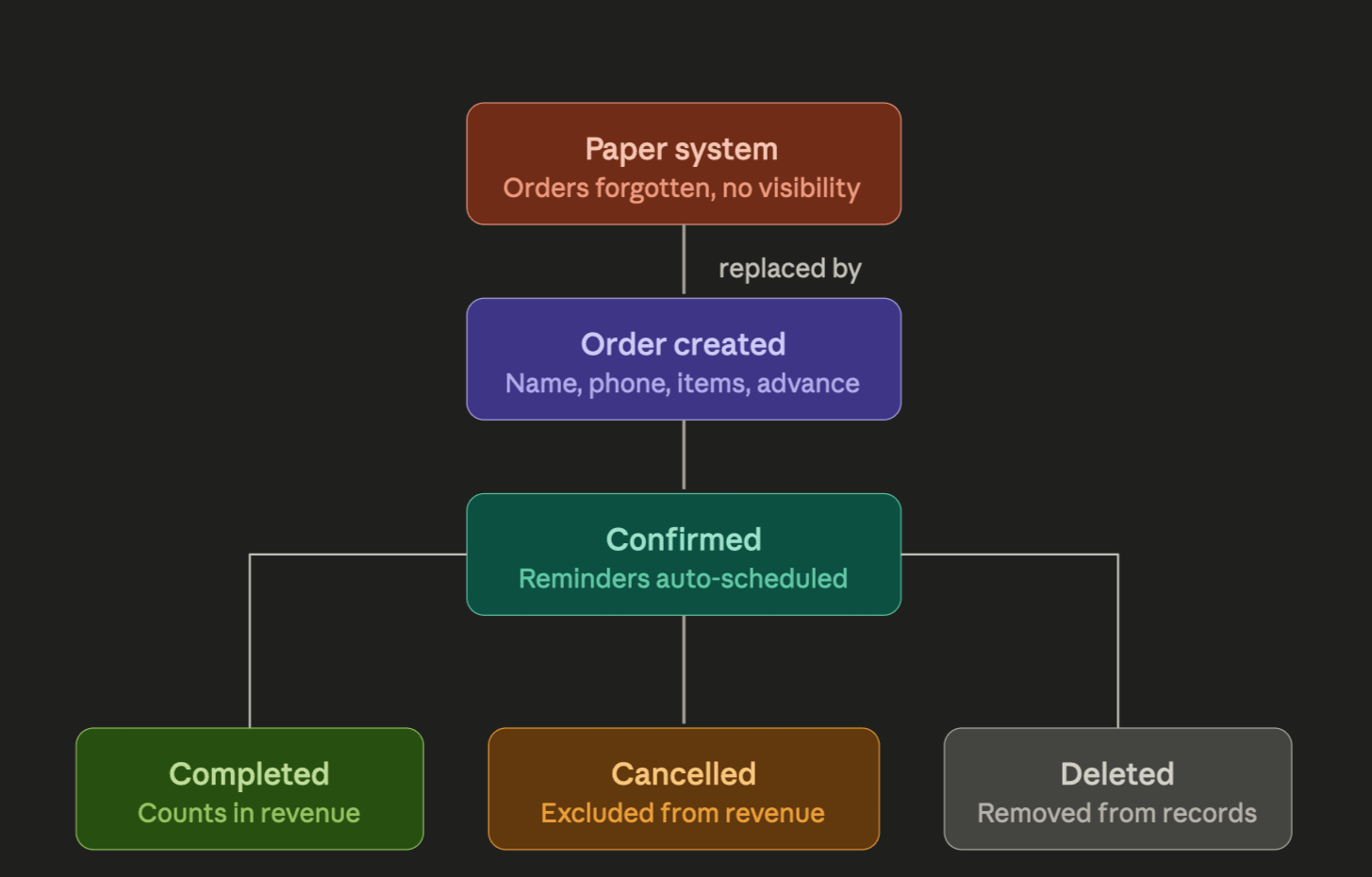

The records live in different places
Bring paper notes, messages and spreadsheets into one agreed phone workflow, with the fields and status changes your team uses.

Airbil is a mobile app development company in Chennai, building business apps and startup MVPs for India and overseas. Turn a recurring task into a clear mobile workflow, with backend and admin tools where needed. See how Hajiyaar handles offline orders, reminders and analytics.
From ₹74,999
For an agreed business-app scope · Excludes GST
Scattered records, unreliable connectivity and missed follow-ups get in the way of daily work. Start with the task your app needs to make easier.
See what we buildBring paper notes, messages and spreadsheets into one agreed phone workflow, with the fields and status changes your team uses.
Identify records and actions that must remain available locally when connectivity drops, then define the connected parts separately.
Build reminders into the workflow so pending tasks stay visible. Define what happens when a record changes or a task is completed.
Start with the journey people need most. Additional roles, platforms and integrations should have a reason to exist before they enter the build.
An internal owner tool, a customer app and a startup first release have different needs. Scope the journey, platform and supporting system together, so the offer explains what the app does and how your team manages it.
Hover or choose a service 01 / 04
Different businesses.
An app shaped around your workflow.
Give an owner or team a focused tool for records and tasks. Hajiyaar combines shop and catering pre-orders, reminders and analytics in an offline app. Your workflow determines the screens and data.
The sample updates locally. It does not create or send an order.
Plan a journey customers can understand and return to. Accounts, payments, location and messaging are available when needed. Their rules, service dependencies and testing scope are agreed separately from the entry offer.
Build a first release around the product decision you need to test. Agree the core journey, supporting data and admin work first. Additional features become separately agreed changes.
Define navigation, wireframes and visual direction before development. Review the main flows and agree a consistent interface. Coding and backend implementation are separate from this design-only offer.
Hajiyaar manages shop and catering pre-orders in an offline-first React Native app. Its records, reminders and analytics run on-device without an account or backend dependency. This delivered workflow shows what can be done locally; connected features have different requirements.
Hajiyaar stores its order information on the device. The owner can work with shop and catering records without needing an account or a live backend connection.
On-device workflow, demonstrated in HajiyaarNative notifications remind the owner about upcoming work. They are scheduled on the phone, rather than depending on a server sending a remote push at that moment.
On-device workflow, demonstrated in HajiyaarWhen an order changes, its scheduled reminders are updated too. The record and the follow-up belong to the same workflow, instead of being maintained in separate notes.
On-device workflow, demonstrated in HajiyaarThe analytics view brings together order and revenue information, including shop and catering breakdowns. It helps the owner inspect the records already captured by the app.
On-device workflow, demonstrated in HajiyaarAgree which records can be read and changed locally. The key task can then work without waiting for a server response. Connected integrations retain their own dependencies.
Payments, live communication and remote data access need connected services. Identify those boundaries before assuming the entire product works without internet.
Hajiyaar uses on-device storage. A shared system needs a separate design for synchronisation and conflicting changes; a local app is not automatically a shared team database.
Agree how information is retained, exported or recovered when a device changes. Those requirements belong in the brief alongside storage and reminder behaviour.
Choose a focused business app, a startup MVP or design-only work. Define the journey, platforms and supporting system in the quote. Starting prices cover an agreed scope; additional features and ongoing costs are identified separately.
Starting from₹74,999
A focused app for one agreed business workflow. The platform and delivery scope are written into your quote.
Starting from₹1,49,999
A first release that connects the core product journey to the supporting system it needs.
Starting from₹29,999
Design the experience before the build. A design-only engagement, with the flows agreed in writing.
Prices exclude GST. Store developer-account fees, hosting, third-party APIs, payment-provider fees, AI and messaging usage charges are separate. Distribution responsibilities are agreed in the quote. Ongoing maintenance and operating-system updates are quoted separately.
Your scope shapes the final quote.
Android, iOS and platform-specific functionality change the build and checking scope. The starting price does not automatically include both platforms or every native capability.
A focused owner workflow differs from a customer app with several roles and account states. We quote the journeys and rules, rather than promising an unspecified number of screens.
Shared records, API services and management interfaces add work beyond a local app. The MVP includes the agreed basic supporting scope; larger admin modules are priced explicitly.
Payments, messaging, location, file storage and AI have different provider dependencies. Development effort and ongoing provider charges are separated in the proposal.
Local storage and shared synchronisation are different requirements. Discuss which tasks must work offline and what happens when connectivity returns before comparing proposals.
Design depth, device checks and the intended distribution route affect the scope. Store accounts, submission responsibilities and ongoing maintenance are agreed separately.
Review the intended users, records and network conditions. Decide which workflow belongs in the first release and what can wait.
Agree flows, navigation and visual direction, including empty and failure states. Record the platform, data and admin boundaries in the written scope.
Implement the app and supporting services around the agreed journey. Review them with relevant data. Scope additional requirements before they enter the build.
Check chosen devices, permissions and connection conditions. Test the local task independently of connected features, including changes and failures.
Agree distribution, ownership and follow-up responsibilities. We fix bugs and crashes after launch; maintenance, OS updates and new features are quoted separately.
Compare platforms, native behaviour and maintenance needs. Our public app case study uses React Native with Expo. Flutter and Swift are also offered; the technology choice follows the product brief.
Hajiyaar is our Expo example, with local records and native reminders. Android and iOS requirements are scoped explicitly; shared code still needs platform-specific checks.
We offer Flutter app development when it fits the product and team. Compare the platforms, integrations and maintenance needs before choosing it. Hajiyaar is a React Native project.
We offer Swift for iOS-focused builds. Agree the intended devices and native behaviour in the quote. Swift is a separate choice from a shared Android/iOS framework.
We offer login, payments, location, chat, camera/uploads, AI features and notifications. Define their rules, providers and ongoing costs before including them in a build. Hajiyaar demonstrates the separate offline workflow above.
Define who can sign in, the information each role can access and how account changes work. The app interface and the backend rules should describe the same permissions.
Connect the agreed payment journey and show useful success, pending and failure states. Payment-provider requirements, transaction charges and the chosen payment flow are scoped separately.
Add location where it supports the task. Agree when access is needed and what the user sees if they decline permission. Continuous tracking is a different scope from selecting a location.
Connect the people who need to communicate within the product. Define participants, message access and the receiving workflow before adding chat to a customer or internal app.
Let users capture or attach the information a workflow needs. File types, size limits, storage and permission states are part of the implementation scope, not hidden assumptions.
Scope an AI feature around a useful task and the data it can use. Agree how its output is reviewed and what happens when it is unsuitable. Provider usage charges are separate.
Choose local reminders or remote notifications for the right event. Hajiyaar demonstrates scheduled local reminders; remote push is an offered capability with a different delivery dependency.
Build the controls your team needs to manage the product and inspect its records. Agree the admin roles, editable information and reporting views with the app, so the operation is considered from the start.
Backend, data and admin work belong in the same brief. Hajiyaar runs locally; connected apps have a separately agreed supporting scope.
Build the interfaces the app needs to exchange information. Agree actions, response states and connected systems alongside the screens, including request failures.
Model the business records and relationships. Agree where information is stored, who can change it and which operations belong on the server or device.
Give your team the agreed controls for users, content or operating records. Define actions and access rules explicitly; the entry scope is not an unlimited management system.
Bring the tools and APIs you already depend on. Review integration requirements and third-party constraints before quoting the connected workflow.
Our Chennai team works with businesses across India and overseas. Share the users, workflow, platforms and existing systems. Delivery, distribution, ownership and support are agreed in writing.

We fix bugs and crashes after launch. Maintenance, operating-system updates, new features and third-party service changes are quoted separately.
On one-time projects, the code and agreed accounts belong to you. Subscription plans stay hosted and maintained by Airbil without code handover. The model is agreed before work starts.
Platforms, workflows, supporting services and distribution responsibilities are agreed in your quote. Developer-account fees and provider charges are separate.
Find a quick answer, or talk through your project with us.
14 questions, answered.Ask us directlyOur mobile app development starts from ₹74,999, a startup MVP from ₹1,49,999 and app UI/UX design from ₹29,999. The final quote depends on platforms, flows, backend/admin scope and integrations. GST, developer-account fees, hosting and third-party usage charges are separate.
It covers an agreed workflow, screen design, implementation for the chosen platform scope, device/workflow checks and post-launch bug and crash fixes. Both platforms, integrations and backend/admin scope are agreed separately in the quote.
The timeline comes with your written quote after the scope is agreed. It depends on journeys, platforms, supporting systems and content readiness. Additional features are separated from the first release.
Yes; the target platforms are defined in the quote. React Native or Flutter can support a shared approach; Swift is an iOS option. The starting price does not automatically cover both platforms.
We offer all three, choosing the route around the product requirements. Hajiyaar, our public app case study, uses React Native with Expo. It is not Flutter or Swift delivery proof.
Yes; Hajiyaar demonstrates local records, reminders and analytics. Define offline scope task by task: payments, live chat and remote services have connected dependencies. Shared cloud synchronisation is a separate requirement.
Yes; we build them where the scope requires them, with data, roles and management actions defined in the proposal. A local app can be simpler: Hajiyaar has no backend or account dependency.
Yes; AI features are offered as part of an agreed app scope. We define the task, available data, output review and failure behaviour before implementation. AI-provider usage charges are separate, and we do not claim that Hajiyaar includes AI functionality.
We have not yet published an app to Google Play or the Apple App Store. For a store-distributed project, developer-account ownership, fees, submission responsibilities and release requirements must be agreed separately. We do not claim past store releases or guarantee approval.
A mobile-friendly website may be enough for a company presentation, catalogue or simple enquiry journey. An app is worth discussing when repeat use, a focused operating workflow or native capabilities justify it. Compare that need with our web development and booking platform options before deciding.
On a one-time project, the code and agreed accounts belong to the client; subscription plans remain hosted and maintained by Airbil without code handover. We agree the model before work starts. Store and third-party accounts have their own responsibilities defined in the scope.
We fix bugs and crashes after launch. Maintenance, operating-system updates, new features and third-party service changes are quoted separately, with no fixed support duration published.
Inspect real apps and compare written scopes, ownership and support terms. Ask about platform differences, offline limits and supporting systems. Hajiyaar is the delivered app Airbil can currently show.
Yes; we work with businesses across India and overseas. Share the users, workflow, platforms and existing systems. The written scope defines delivery, ownership and support responsibilities.
Tell us who will use the app, what they need to do and which systems you already depend on. We will discuss your platforms and offline requirements in a free consultation, then quote the agreed scope.